Welcome to Your MindTime® Thinking Style Report
Unlocking the power of your thinking
MindTime offers you a new and exciting perspective on yourself and everyone around you.
In this first section – How Your Thinking Works – we provide you with a brief explanation to help you get the most out of this new way of understanding how we all think. However, you can skip past this section and come back to it later if you’re intrigued by what you read about yourself. We hope you will be.
In its effort to help you survive and succeed your mind is always doing three things:
- Accessing the collected and stored experiences of the past to gain certainty and lower risks
- Creating and adapting plans and organizing resources in the present to maintain stability and increase the probability of it reaching its immediate and longer-term goals
- Re-imagining the future by looking for possibilities to solve problems and have new ideas

This perspective moves towards Certainty as a priority. It orients itself around understanding, meaning, facts, data, and research. It cares about what is factually true and how that information applies to current issues or decisions. Its core need and virtue is to know and protect what it believes is the Truth.
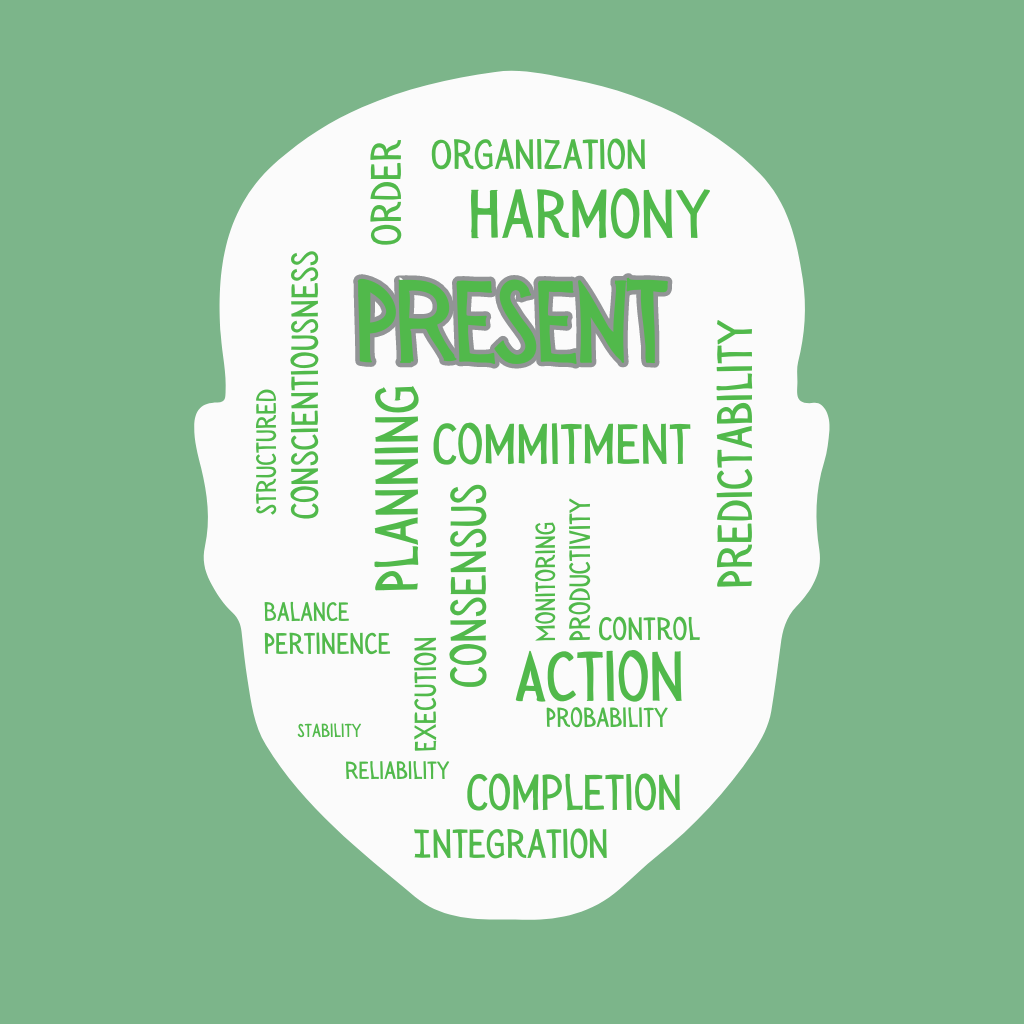
This perspective moves towards Probability as a priority. It orients itself around norms, order, structure, schedules, and stability. It cares about maintaining the status quo and making sure that things are working normally. Its core need and virtue is to feel and bring Harmony.

This perspective moves towards Possibility as a priority. It orients itself around opportunity, change, novel ideas, and inventiveness. It cares about the big picture and staying open to what is possible. Its core need and virtue is to find and bring Hope.
Each one of us combines these three perspectives of time in varying proportions. Your Thinking Style emerges from this unique blending and influences every facet of your life including your personality, making your Thinking Style an intrinsic part of who you are and the bedrock of your worldview. It remains remarkably consistent over the course of your life providing a stable foundation for your interactions with the world and the experiences you have. It also makes you wonderfully unique!
SNAPSHOT
You seek possibilities and solutions
Your thinking is oriented towards chasing after the many opportunities that lie in front of you. You become energized by the possibilities you see and your energy is infectious, often sweeping others along with you. You’re always coming up with new ideas, finding solutions, and driving change with your ideas of how things could be. You intuitively understand how people ‘tick’ and benefit from trusting your gut; it’s rarely off. You only continue to invest yourself in something as long as it holds your attention and you feel hopeful that you can get what you want from it, the result is that many things lie unfinished. Not necessarily a bad thing!
You will always be driven by Possibility often imagining the next big thing, remember, intuition is your ace card. Use this ability as your foundation and align your efforts with what you do so well.
You have
- A contagious enthusiasm and openness toward others
- A willingness to tackle challenges; often delivering very novel solutions
- A desire to stir things up, change things, and make your ideas known
- An attraction for things that reflect your creative, spontaneous nature
- A knack for finding solutions to sticky or impossible problems
- A flair for selling yourself and your ideas

Your Thinking Style badge
Maximize Your Strengths
When you recognize future opportunities before most people would, use all your creativity and drive to take advantage of them before they’re gone.
- Do follow your dreams. While some people may think you have your head in the clouds, you see something magical and there’s true wonder in that magic.
- Do think about how focusing a little more of your attention on what’s happening around you now may help you achieve every task you’ve set for yourself. Being a dreamer is great – making those dreams a reality is greater.
Growth Opportunities
Focus more on organizing what’s happening in the present moment and use what happened in the past as information to help you make smarter choices.
- Don’t let people who need facts or figures stop you from achieving the greatness you know you’re capable of. The future isn’t waiting for you – it’s your playground and you know that you need to actively go after it if you’re going to succeed.
- Don’t forget to stop every now and then and take a look back. Is there anything you can learn from your past? While you might not think it as important as what’s waiting for you up ahead, you might be surprised to see patterns you’ve been repeating that could be changed to your advantage.
IN DETAIL
Now that you’ve read a little about your way of thinking, we want to introduce you to your Intensity Chart, which reveals the blend of the three perspectives in your Thinking Style, and the MindTime Map, which pinpoints your position within the MindTime framework of thinking.
You lead with FUTURE thinking
The higher your score on a particular perspective the more prominently that perspective, along with its defining characteristics, influences your thoughts and actions. Conversely, if your score on a perspective is low, you may experience increased anxiety, stress, and even a sense of unease when required to employ it. Lower scores are experienced as resistance to the kind of thinking and behaviors that are linked to that perspective, making you feel hesitant or uncomfortable when having to use them. Let’s take a look at each perspective and examine your individual scores.

This expresses itself as the part of your mind that strives to have available as much information as possible to inform decisions and behavior.
It gets this information from past experience, knowledge, and known sources of information.
It wants its information to be accurate, truthful, and meaningful, and so refuses to take anything at face value; it needs to be certain.
Always taking the truths that it has derived from accumulated experience and comparing them with the current situation, the Past perspective evaluates, validates, researches, weighs pros and cons, and judges credibility.
Refusing to trust that “everything will work out,” it uses knowledge—its command of the past—to reduce the risk of negative outcomes and increase the possibility of positive ones. Past mind is, above all, reflective.
Your score:
This perspective is responsible for:
- How much Risk you tolerate (the higher the number the LOWER your tolerance)
- How much Time you need to reflect on new information (the higher the number the more time you need)
- How much Information you need to feel like you understand the risks (the higher the number the more information you need)
If you have a low score on Past perspective this may be a stumbling block as you may often forget to look back at your mistakes and learn from them. You might be less discerning in your thinking, this could lead you to make decisions without giving due consideration to facts, what is known, or lessons learned. You will be less critical of the information you use, potentially resulting in errors in judgment. In essence, you might skip the vital step of reflecting on what is known and its relevance to your decisions before taking action.
Explore how resistances manifest in your Thinking Style and learn strategies to overcome them. If your scores are below 40 on any perspective, delve into this section to gain insights and tools for navigating challenges. Even if you don’t experience resistance, understanding others’ perspectives can be invaluable.

This is that part of your mind that works to gain some measure of control over the unfolding future to create stability and predictability.
It is therefore motivated to monitor the surrounding world, structure its environment, devise alternatives, and execute plans of action to achieve goals. It values stability, productivity, harmony, and closure and respects existing rules and regulations and the status quo.
It will do everything it can to follow through with its plans and to honor commitments. It abhors chaos and confusion and is driven to establish order, create structure, and get things done. Present mind is, at its core, practical.
Your score:
This perspective is responsible for:
- How much Chaos you tolerate (the higher the number the LOWER your tolerance)
- How much Organization you need in your affairs (the higher the number the more organized you need to be)
- How important stability and security are to you (the higher the number the more important)
If you have a low score on Present perspective this may be a stumbling block as you will struggle to follow through on tasks, meet deadlines, and stay organized. This can make it challenging for you to manage details, honor commitments, and maintain consistency in your daily responsibilities. Your resistance to the behaviors of Present perspective may result in difficulties in keeping up with day-to-day activities and commitments, which could lead to disorganization and inefficiency in your life.
Explore how resistances manifest in your Thinking Style and learn strategies to overcome them. If your scores are below 40 on any perspective, delve into this section to gain insights and tools for navigating challenges. Even if you don’t experience resistance, understanding others’ perspectives can be invaluable.

This is that part of your rational mind open to future possibilities. Future Thinking seeks out the opportunities offered by those possibilities and wants to open up new vistas for what the future might hold.
It develops visions, often promoting them with enthusiasm and energy, making up strategies and tactics along the way, on the fly.
Future Thinking pushes the limits of what is known and understood.
It is open-ended and comfortable with change and ambiguity; it chafes if confined within structures.
It needs the pressure of deadlines to generate motivation to bring something to completion. Future mind is, in its essence, imaginative.
Your score:
This perspective is responsible for:
- How much Change you are comfortable with (the higher the number the greater your comfort)
- How much appetite you have for pursuing Opportunity (the higher the number the more opportunities you seek)
- How much Resilience you have for coping with adverse conditions (the higher the number the more resilience you have)
If you have a low score on Future perspective this may be a stumbling block as you may often assume that you’ve already thought of all possible options and miss opportunities for future success and happiness. You will struggle to adapt to changing realities and show inflexibility when asked to consider new ideas or direction. This may lead to getting stuck in a rut, hesitance to explore new options, and a tendency to overlook new solutions that could be beneficial to your reaching your goals.
Explore how resistances manifest in your Thinking Style and learn strategies to overcome them. If your scores are below 40 on any perspective, delve into this section to gain insights and tools for navigating challenges. Even if you don’t experience resistance, understanding others’ perspectives can be invaluable.
[mindtime-survey-independent-question id=”489″]
[mindtime-survey-independent-question id=”494″]
[mindtime-survey-independent-question id=”490″]
[mindtime-survey-independent-question id=”495″]
NARRATIVE

How you are in the world
When you let go of your irrational fears and over-sensitivity to other’s judgment, you can fly. You have a level of confidence that sometimes borders on cockiness. You know the strength of your skills, and that when you flow, you’re capable of amazing things. When your skills are unleashed, your flow creates an almost spiritual quality to any experience.
Your flow is linked to intuition, not facts. You catch the scent and follow your nose. Thanks to your cockiness, you know that despite past facts and present rules, you need to follow your heart when you’re inspired, even if it doesn’t seem like the logical or necessary thing to do.
Challenges are an important part of your flow. While others might find challenges restricting, you thrive on them. You work best proving that nothing is impossible. You use your skills to bring all the elements together to meet any new challenges. Sometimes, too many challenges. Ever feel like Atlas, carrying the weight of the world on your shoulders? Remember that the success of your flow has nothing to do with taking on more challenges than you can handle. Maybe you need to commit to completing one new challenge before moving on to the next. You flow best when you’ve got nothing like facts or a plan holding you back.
The catch-22 is that without some facts and plans to tie the energy together, your flow might hit the brick wall later down the line. If you could add the awareness of finding all the information you need to be informed or the awareness of putting a plan together, you might find your overall flow much more fluid.

What you bring to the world
Stupid is as stupid does. This isn’t something you learned from books – it’s something you learned from experience. It’s these life experiences that have molded your outlook and created your street-wise wisdom. The complexity and fluidity of life don’t follow a plan and can’t be summarised on the page. It has to be lived. To see the next opening before anyone else. To truly integrate the organic process that is life. This is your wisdom.
What the books say and what the rules say are left to other people in your world. Your wisdom is about taking each case as unique, about “feeling” what’s right and wrong rather than being told. It’s a flexible, liberal wisdom that you use to manage life: the wise old person who intuits the future by reflecting on a life that’s been lived, not studied. But then again, if you could add book smarts to your repertoire, you’d be a sage as well as a seer. Your street-wise wisdom gives you values that are shaped by experience. You’ve got an open mind about how things are, something you’ve earned by traveling (both physically and mentally), and meeting and savoring the different people of your journey.
Your open-mindedness is not closed down by the rules or traditions that constrict people with other kinds of awareness. In fact, you might find yourself clashing with them. It’s like you’ve seen the light and can’t understand why others won’t. But remember to keep patience with those who don’t share your liberal wisdom and open-minded values.

How you see the world
What is truth? In your heart, you know that truth is empirical. It’s flexible rather than solid. It’s a complex tapestry of various shades and patterns. This malleable view of truth is the by-product of your practical street-wise training.
Did Joe and Bob commit the same crime? Yes? Then they’re both guilty, right? Mmm… perhaps not in your eyes. There were different conditions and different reasons. There were different “whys” and “hows”. And the truth is a melting pot of everything, including emotions and other intangibles, rather than just the cold, hard facts. Cold hard facts! What are they? Cold had facts and $5 will buy you a café latte, but that’s about it. Thankfully, there are people like you who take a more organic approach to what the truth is. If the rigid truths of others were all we had, we’d be living in an Orwellian nightmare of absolutes.
If science has proven anything to us over the years, it’s that there are no absolutes. There are only “probables” until new truths prove otherwise. Your adaptive truth can really handle these changes. But as great as this flexibility is, make sure you don’t forget to see these “probables”. Don’t fall into the trap of making up the truths that suit you in order to have things your way. Never forget the expression on Bill Clinton’s face when he addressed the nation and told us what he believed “the truth” to be!

You in relationship
You are the idea person who drives passion
We all have relationships, they’re a natural and important part of most people’s lives. Why is it that even in our most intimate and important relationships we struggle, at times, to make things work, to understand each other, to see eye-to-eye? The simple fact is that we do not think the same way. We each bring our own point of view and use that to further what is important to us in the moment, whether it be in our private life, our work, or with friends.
Knowing how we think helps us to hear with more compassion. To listen and hear beyond a person’s words. To understand where they are coming from, what they need, and where they are trying to get to in conversation with us.
Find Out How You Relate With other Thinking Styles
Choose a colleague, friend or partner’s Thinking Style from the selection below to learn how you relate with them.


Pros
When you both agree on a vision, they can help do the research that makes certain it’s a real possibility and not wishful thinking.
Cons
Without some present planning to keep things organized, you might be lost in coming up with new possibilities and having them shoot these down with research. They may hold you back; you may be leading them out of their comfort zone.

Pros
Working as a team, you can realize a brilliant future together and make plans for it.
Cons
You’re not naturally the planning type. They seldom ponder too far into the future but prefer to take control over what’s happening right now. It’s going to take understanding and compromise to see your way to a common ground.
Pros
You both share an understanding of the dynamics of a Future thinking style. You both love new ideas and experiences and seeking new opportunities.
Cons
You both have strong visions and sometimes they may conflict. While you’re willing to compromise, there are limits, and your vision will have to be met.

Pros
In an ideal world, you’d complement each other’s thinking styles. You’d bring the vision of a possible future, they’d help research the evidence and plan for it.
Cons
We’re not living in an ideal world, so they may grow tired of your future-based need for new and exciting adventures just as you may grow tired of their need to play it safe and plan everything.

Pros
You both share a need for envisioning all the possible futures available to you. If you can factor in their need to have some facts to back up your decisions, things can work well.
Cons
You don’t always need those facts, though, and neither of you is a whiz at planning what to do now. When you let them down once, they will remember it forever.

Pros
If you can communicate your needs, you’ll complement each other. Your vision of the future and their planning and need for the safety of facts can lead to very fulfilled lives.
Cons
Chances are you won’t see eye-to-eye without great empathy for each other’s way of doing things. They may find you flaky and ungrounded. You’ll probably find their strict adherence to rules and constant need for information to be a drain on your exciting pace.

Pros
You share an understanding of the Future thinking style; both of you are looking for new experiences.
Cons
They get to the Future thinking style by first going through the control and organizational needs of a Present perspective. Just as you’ll have trouble dealing with their need for plans, they’ll have trouble with your need to jump from one opportunity to the next.

Pros
You both look to the future for new opportunities and can share a rich life of exploring new experiences together.
Cons
While you’re willing to go for it, you may find they’re more cautious, always wanting a little more information. You may feel frustrated by their need to gather facts.

Pros
You both share the joy of new experiences and ideas. You both hunger to seek out the best life has to offer.
Cons
They need to have some control over where they are and what they’re doing. This means organizing, structuring, planning—things you don’t naturally do and find slow down the flow. Conflicts can arise when you both want things your own way.

Pros
This could be harmonious. Connectors will understand where you’re coming from, even if they don’t agree with it.
Cons
You may find them too wishy-washy and diplomatic. Do they always have to be so understanding? Having a Future thinking style means you have fire in your belly and they’d better be able to keep up with that.

You in collaboration
The value of your Thinking Style lies in the ability it gives you to envision what others cannot yet imagine. You are often the one to conjure up new solutions to problems that have confounded others, even if you cannot always explain how you arrived at your solutions. Professor Edward de Bono called this ability Lateral Thinking. You also have the ability to have and hold a vision of a different future from the one that is unfolding. This requires you to take the long view with an open, unfettered mind. It also requires you to be tenacious.
The development of your ideas is often an iterative process that takes shape as you work to describe your vision with ever greater fluency to other people. This kind of polishing of the diamond requires the ability to see things as a fun challenge when you counter the obvious skepticism in others. At first, when you share your ideas with others, not everyone can overcome their doubts. Some people will give you real pushback. This is where your resilience comes in. Rather than pack up and move on, you find this skepticism a welcome challenge to help you fill in more details to explain your idea.
It is also true to say that you don’t finish polishing all of your diamonds. Finishing what you start is probably not your strong suit. Change is in your nature and you are quickly bored by conformity and repetition. Your great strength lies, in part, in your ability to play with boundaries and ignore others’ rules or expectations of how things should be done.
Your true gift is one of passionate communication; you foster a culture of enthusiasm and hope.
- You champion innovation, focus on solutions, and help others begin to think outside the box.
- You inspire others and remind them of the bigger picture.
- You help the group adapt to new circumstances.
The 10 Collaboration Styles
The secret to happiness and success is knowing where to look for the value in ourselves and others. When you’re aware of your colleagues’ Thinking Styles and the value each brings—especially when they are different from you—you can partner to create mutual success.

Past thinkers help the group develop a deeper understanding of its mission.
They teach people how to reduce the risk of failure and measure progress realistically.
Their skepticism and independence militate against “groupthink” and blind conformity.
Present thinkers keep their teammates focused on outcomes.
They ensure that goals are realistic and the group doesn’t take on more work than it can handle.
They hold people accountable and make sure they honor their deadlines and commitments.
Future thinkers champion innovation, focus on solutions, and help others begin to think outside the box.
They inspire others and remind them of the bigger picture.
They help the group adapt to new circumstances.
Information and organization are both important to people with a Past-Present Thinking Style.
They are likely to manage the group’s data, adding to it with their own thorough research.
Their caution and practicality provide a solid foundation for decision-making. They help the group avoid unnecessary risks.
Past-Future thinkers ensure that the group makes decisions with full knowledge of the risks and consequences.
Others come to rely on their experience and wisdom.
They are good at detecting when rules and structures become too confining for the group.
Present-Past thinkers create efficient systems: organizing information, people, and the flow of work.
As team players, they help the group stay focused on its collective goals.
They promote accountability, reliability, and trustworthiness, helping bring projects to completion.
A Present-Future thinker’s attention to trends and changing markets is a valuable contribution to the group.
They encourage others to act in a timely manner.
They combine vision, action, and a knack for organizing. People say that they are natural leaders.
Future-Past thinkers help the group set goals with a “grain of salt,” insisting that their vision be backed up with solid facts.
They counsel against snap decisions.
They find it easy to motivate others because they’re confident that their goals are viable.
These people make sure the group grabs new opportunities before it’s too late.
They are more open to change than most Present thinkers, and understand the benefits of deviating from a plan.
They are inspiring but pragmatic.
Integrated thinkers have an unusual ability to engage all thinking styles, and they have a clear understanding of group processes.
They sense when members are focusing on only one thinking style and a minority perspective is being pushed to the margins.
People with this Thinking style serve as a mediator, help resolve conflicts, and keep everyone focused on constructive interaction.